Devon Island Expedition

Devon Island Expedition
This blog features educational updates on my Devon Island Expedition of July 14-20, 2007. Other sites: spaceref.com/blogs/earthclassroom, www.marsonearth.org

Saturday, May 23, 2009

Life in Space –Onboard Basics


Ok, so someone wanted to know what the International Space Station smells like. After we opened the hatch, I noticed a moderate smell of plastics, not unlike that new car smell. That’s from the various synthetic materials onboard, outgassing. It’s not too bad, and after an hour, I stopped noticing it.


We do scrub the atmosphere, though. We have carbon dioxide removal systems,


as well as a micro-impurities removal device. Oxygen is added of course, as it is consumed. We use an electrolysis device to crack water, dumping the hydrogen overboard.


That device is a bit cantankerous, so we also have oxygen candles, which we “burn” periodically. These are the same kinds of systems that are onboard nuclear submarines, which face similar technical requirements.


One interesting fact, is that nitrogen is not replaced, except to compensate for leakage. The human body does not really utilize the inhaled nitrogen, so it is recycled.

What else? What is the temperature onboard? The temperature was set by the Mission Commander (me). I live in Houston, so I like air conditioning. The cabin was set to about 70 degrees F.

You have all read about how to brush your teeth in space. Anyone want to take a stab at how to clip your nails? I’ll write about answer in the next installment.

And, I’ll address what you really want to know, on Friday.


Leroy Chiao

Originally posted on Gizmodo, during the week of 5/3/09

Friday, May 22, 2009

Life in Space – The Beginning (Soyuz)


Last time, I wrote about what launching aboard a Space Shuttle is like. This time, let’s consider the Russian Soyuz rocket and spacecraft. Why? Isn’t a rocket a rocket? Is it really that different? Yes and no, no and yes. They both get astronauts into space in around nine minutes. But, they are very different.

First, consider the two spacecraft. They look pretty different from each other. One is a part of a missile, the other a winged vehicle, attached to a rocket assembly.


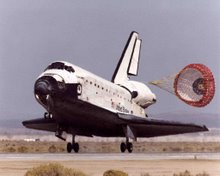
If the living space inside of the Space Shuttle is Business Class,


then the Soyuz is decidedly economy.


However, I must say that the Soyuz has a very special place in my heart. It is a robust, capable spacecraft and launcher. It has the best-demonstrated safety record of any manned spacecraft. And, it just feels hearty.

But, how does it feel to launch on a Soyuz?


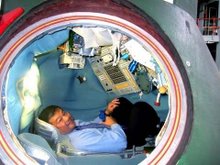
Well first, you almost wear the Soyuz rather than strap into it. Squeezing down the hatchway into my seat, I got an idea of what claustrophobia must feel like. If anyone is the least bit claustrophobic, this would bring it out. Your legs are bent up into your chest. It’s not very comfortable. Like with the Shuttle, you strap in about two and a half hours before launch. But, it gets worse. The Soyuz requires two orbits to get enough telemetry to the ground, for the Mission Control Center to verify that the spacecraft is healthy. During that time, you must remain strapped into your seat, in case you have to perform an emergency deorbit. Total time in that position? About six hours.

So, there’s no dozing off in the Soyuz, you’re too uncomfortable. You wait. And follow along in the checklist, of course. T-Zero is totally different - there is no kick, since there are no solid rocket strap-on boosters. The liquid engines are very smooth. The thrust builds up gently until the rocket simply rises off of the pad. You have to go by your watch, and the announcement from the launch control bunker to know that you are flying!

There is a deceleration just prior to staging, and then a muffled “bang!” as the four liquid strap on boosters separate. Same for the third stage. What surprised me (startled the Hell out of me, actually), was the very loud “BANG!!” followed by an instant flash of bright light. Just for a split second, I thought we were exploding, but it was just the shroud and escape tower separation! I could now see through the porthole, and look down at the familiar view of the Earth, and the bright, fluorescent blue line of the atmosphere on the Earth limb.

You know the rest.


Leroy Chiao

Originally posted on Gizmodo during the week of 5/3/09

Thursday, May 21, 2009

Life in Space – The Beginning (Space Shuttle)


Today, I was going to write about how to do something else in space. But, I changed my mind. Let’s back up to the beginning of a mission. What’s it like to go through a launch? How does it feel? Are you able to sleep the night before? Do you get scared? What do you eat before?

Steak and eggs. Medium rare, and over easy. This is what the first astronauts ate before launch and why not? I remember during one of my launch counts, the ladies were taking our prelaunch breakfast orders, going around the table. I was hearing things like, dry toast. A little yogurt. Cereal. You gotta be kidding me, what kind of panty-waists am I flying with? They got to me and I replied firmly and evenly, “steak and eggs, medium rare, and over easy.” Everyone looked at me funny. I stated the obvious. “Hey, we might go out tomorrow and get blown up. I’m going to have steak and eggs!” Immediately, three guys changed their orders to steak and eggs. I was doing all of us a favor, really. You need a hearty breakfast before launch, you’re going to be really busy. Yogurt? Come on.

Sleep wasn’t really a problem either, although I tended to wake up a few times at night in anticipation, just like when I have other important morning appointments. We usually wake up about four hours before launch, and hit the ground running.

After breakfast and cleanup, it’s time to get suited up. Walk down the hall and meet up with the suit technicians. Seasoned professionals, your suit tech has been with you all through training. He or she makes sure that everything is just right, and after the pressure checks are complete, sends you on your way.


From that point, it’s a bit of a blur, as you walk out of the Operations and Checkout Building at the Kennedy Space Center, to the applause of the employees who have gathered at the entrance. You climb onto the Astrovan, which is a converted Airstream RV from the Apollo days. Crews typically joke and banter a bit, the atmosphere is light hearted, during the short drive to the launch pad. Everyone falls silent, as the bird comes into view. She is beautiful. She is ready, as are we.

At the pad, we climb out and ride the elevator to the 195 foot level, where we are greeted by the ingress crew. Time for one more quick pee. Maybe for good luck, but more, so that I won’t have to use the adult diaper that I’m wearing! After all, we strap into the Space Shuttle about two and a half hours before launch.

Is this when the jitters hit? Actually, no. This is kind of a time to relax a bit. The environment is totally familiar, thanks to the hours upon hours spent in the simulators. For once, nobody is talking to you. Nobody is asking you for something. It’s not unusual to doze off.

As the launch count proceeds, there is a point at which things get serious. Certainly as we come out of the T-20 minute hold. After we come out of the T-9 minute hold, the cockpit is sterile. No unnecessary chatter on the intercom. Is this when it becomes real? Not just yet. For me, it is not until the T-90 second point, when the Launch Director says something like “Columbia, close and lock your visors, initiate O2 flow, have a good flight.” That it becomes very suddenly, very real.

What did I feel at T-Zero? The answer might surprise you. I felt relief.


Certainly, I was keyed up. After all, we were sitting on top of a bomb, being accelerated to orbital velocity of 17,500 mph in less than nine minutes. Pretty heady stuff! But the thing of which astronauts are most afraid, is not getting the chance to launch into space. What if I get hit by a car? What if the doctors find something wrong with me at the last minute? What happens if…..All of those worries go away, the instant the boosters light!

First stage on the Space Shuttle is shaky. You can’t really read the instruments and screens very well. At T-Zero it feels like someone kicks the back of your seat really hard, the Shuttle seems to leap off of the pad. You hear the wind noise build into a high-pitched whine. You see the blue sky start to get dark, fairly quickly. You don’t so much hear the rumble of the engines, as feel them. Everything is oddly orderly, even quiet. That’s because we are accustomed to the simulators, when all the warning and emergency lights and klaxons are going off, as we deal with the failure scenario presented to us by the training team. On launch day, pretty much everything usually works!

On my first flight, I was up on the flight deck for launch. I had a small mirror, through which I could look out of the overhead windows, which were pointed more or less towards the Earth (The Shuttle rolls into launch azimuth and heels over as the ascent proceeds). I saw the ground rushing away, through the flames of the engines.

After about two minutes, the Solid Rocket Boosters (SRB’s) tail off as the last bits of fuel in them are consumed. You feel the deceleration, and then see the flash of bright light as the separation motors fire, peeling them away from the stack. It is suddenly very smooth and quiet. My heart leapt into my throat when this happened to me the first time. My first thought was that the main engines had also stopped and we were about to go down! But, that was not the case, I just hadn’t expected second stage to be so smooth.

During the last few minutes of launch, the vehicle accelerates to orbital velocity. You are under three G’s of loading, so it feels like a small gorilla is sitting on your chest. It takes a little effort to breath, but it’s ok.

Suddenly, right on cue (you’re always watching the clock), the main engines cut off, and you are instantly weightless! As I looked out the windows and for the first time beheld the awesome beauty of the Earth from space, I was almost overcome with emotion. I had made it, I had realized my childhood dream. I allowed myself to revel in this moment for just a few seconds. Yes, I was in space, but it was also time to get to work!


Maybe tomorrow, I’ll tell you about the Soyuz.


Leroy Chiao

Originally posted on Gizmodo, during the week of May 3, 2009
Wednesday, May 13, 2009

Life in Space – A Day (or at least, the beginning of one)


On a Space Shuttle, music is piped up from the Mission Control Center. On the Space Station, you set your watch alarm. Or, as is sometimes the case on Earth, you awake early, all on your own, wondering “What the H..?!”

A typical day in space (is there such a thing?) starts a lot like a day on the ground, except that you are floating. Turn off the alarm. Unzip yourself out of your sleeping bag. Open the doors to the sleep station, haul yourself out.

You can do it however you like, but on the International Space Station, I fell into a routine of cleaning up in the evening before bed, and then wearing a clean T-shirt and underwear for sleep. In the morning, I was already half dressed. I would pull on a pair of Nomex shorts and white cotton gym socks, ready to get going. This was the typical uniform onboard, except for when the cameras were going to be on.


When we had a scheduled video interview, we would wear a polo-type crew shirt, or in the case of a serious event, don a flight suit.


What’s the first thing you do in the morning on Earth? Well, it’s not so different onboard a spacecraft. Why should it be? However, I will dedicate another entry to the issue of space toilets and leave it alone for now.

How about something like brushing your teeth? In zero gravity (or more accurately, microgravity, if you’re a stickler for such things), some things are easier, like moving medium or large mass items around, but many things are more difficult. It is unbelievably easy to lose things. Get distracted for a moment, and that toothpaste cap is gone! Even if you are good about anchoring such things behind a rubber bungee, some rookie going by could knock it loose for you.

So, how do you brush your teeth in space? Long ago, NASA started buying only toothpaste without detachable caps, thus solving the lost cap problem. So, start by filling a drink bag with water and bring it with you to the hygiene area. Tuck it behind a rubber bungee. Remove your hygiene kit from behind its bungee and unzip it. Find your toothbrush inside of your hygiene kit, safely tucked away inside of a fabric pouch with a Velcro top. But first, take out your toothpaste tube, and stick it to the wall, using the Velcro dot on it. Secure your hygiene kit behind a rubber bungee, after partially zipping it up, so that things don’t accidentally float out.

Still have your toothbrush between a couple of your fingers? Hopefully yes. Remove your drink bag, and with one thumb, flip open the straw clamp (which keeps liquid from seeping out of the bag), and gently squeeze out a bead of water onto your toothbrush, watch it get sucked into the bristles. Hold the straw of the drink bag in your teeth, and with one hand, fix the straw clamp in place, and replace the bag behind the bungee.

Almost all of the rest is fairly straightforward. Flip open the cap of the toothpaste tube, squeeze some out on your toothbrush, go to work on your teeth. Ok, you’re done. Now what? Where are you going to spit? There’s no sink……..So, into a tissue? Then you’ve got a wet tissue, and what are you going to do with that?? So, I swallowed. Filled my mouth with water and swallowed again. Drew some water onto the toothbrush and sucked the water out. Dried the toothbrush onto a towel and replaced it, and the toothpaste, into the kit.

What’s left? Any idea? Yep, the drink bag. That, I would bring to bed with me, so that I would have something to sip on in the middle of the night, should I wake. Just like back home on Earth, except a bit more complicated. And, brushing your teeth is one of the simpler tasks that you’ll perform in space.


Leroy Chiao

Originally posted on Gizmodo during the week of May 4, 2009

Life in Space – The Basics


“So, what’s it like?” Living in space is all at once wonderful, and a royal pain. During my first mission aboard Space Shuttle Columbia, I marveled at the sensation of freedom that came right after Main Engine Cut Off (MECO). I watched as tethered checklists floated gently back and forth, and it quickly became normal to release a camera lens in midair, as I removed the old one off of the camera to be replaced.


There was also a sense of dizziness, since the inner ear balance system wasn’t working so well. My head felt a little full, as if I were laying down on an incline, since there was no longer any gravity to pull fluids down to my extremities. In fact, the human body carries about two liters less water in space, than on the Earth.


But, it was amazing how quickly it became normal, just to fly head first down a hatchway, or to spin myself with a push off using just a few fingers. With a little practice, most astronauts get pretty graceful at flying through the spacecraft. Just don’t try it at home, back in gravity!

Large masses are easily moved around slowly, and it becomes second nature, to orient yourself using only your vision. However, what about all that other stuff?

For example, imagine how easy it is to lose something! Where did that pen go? Where is my thumb drive? Where is that photograph of my family? First place to check is the air filters. But, there are plenty of dead zones of air inside, and things can be lost for a few minutes, hours, days, weeks, months, or forever. If it’s critical, you had better keep it inside of a sealed bag, safely contained inside of a second, large mesh bag, tied off to a handrail.

What about eating in space? Hygiene? What is the coolest thing about being in space? What is the most difficult? Stay tuned, I’ll be writing about all of it.


Originally posted on Gizmodo, during the week of May 4, 2009

Thursday, April 23, 2009

UFO's?

Who's seen a UFO? I have, on two of my space missions. However, I figured out what the first one was, and I have a pretty good idea what was the second.

On another mission, Houston called to inform us that an expendable launch was about to take place from Cape Canaveral. After the third stage burned out, we watched a wonderfully beautiful rainbow in space that expanded into a huge oval, as the excess fuel was vented into space and caught the sunlight just right. If Houston had not warned us, I would not have been able to explain this, and would have found it very eery!

I firmly believe that there is other life in the universe. What I am more skeptical of, is whether we have been visited by extraterrestrials.

I must admit to being a bit intrigued when well-known colleagues come out and publicly accuse the US Government of covering up UFO evidence. Edgar Mitchell and the only other Leroy in the history of the program (Gordo Cooper) have both claimed that this is the case.

If we have been visited by aliens, I don't have a problem believing that the US Government would try to cover it up. However, would they really be able to do it? Have they done a very good job of covering up other things in the past?

What do you think? Have you seen one?

Leroy Chiao

Sunday, April 5, 2009

North Korea Missile Test - So What?


North Korea has launched a Taepodong 2 missile, in what appears to be at least a partially successful test. The world, led by U.S. President Barak Obama, has condemned the test. Analysts and media pundits warned of a destabilization of the area, and indicated that it signaled a threat to U.S. Homeland Security.

Was the flight a success? In an earlier test (2006), the first TP-2 missile exploded about 40 seconds into flight. The North Koreans seem to have fixed that problem, but the U.S. and South Korean military have both stated that the current rocket failed to put anything into orbit. That seems to indicate at least a third stage failure.

In theory, the test shows that the North Koreans could fire a missile and possibly hit Japan, the United States and any number of other countries. Of course this is cause for concern, but how concerned should we really be?

First, the test was not completely successful. One could argue that the North Koreans were lucky to get as far as they did. What would happen if they launched another missile today? They are maybe 2/3-1 for a record so far.

Second, as in the Iranian tests, what can they hit? Their guidance systems, by all accounts, are not very sophisticated.

Third, how many could they build and launch? The North Korean infrastructure is pretty thin. Does anyone think that they could not be stopped at any time militarily, should the need arise? Even if left alone, when could they launch another missile? Do they even have one ready to go? It took them almost three years to launch their second test.

Fourth, we all know why they did this. It's just to get attention and try to squeeze more money out of the West.

I must admit to feeling that this is a "So What" moment.

Leroy Chiao