The Orlando Sentinal and other publications reported recently that NASA, at the very highest levels, is not cooperating with President-Elect Obama's NASA Transition Team. There was reportedly a very public, unfriendly exchange at a book publication event at NASA HQ between Administrator Mike Griffin and Transition Team Leader Lori Garver.
There seems to have been enough eyewitnesses to this and other incidents, that it would be fair to conclude that something bad is happening. What's going on at NASA? It's hard to know for sure, but it sure smells like a combination of desperation and frustration. No matter what one's opinion happens to be, the fact is that there will be a new President in just a few weeks and his transition team for space is going to be advising him on everything that should be done with NASA.
If Mike is afraid that the Constellation Program is about to be canceled or radically altered, the best course of action would be to calmly make his arguments to the Transition Team, to try to persuade them that his course is best. They are the ones who will be calling the shots. There are rumors that Ms. Garver herself may be in line to become the next NASA Administrator.
It may be a losing strategy for Mike to simply try to persuade, but it's going to be a lot better than confrontation.
And, who is Ms. Garver? She was the NASA Associate Administrator for Policy and Plans when Dan Goldin was NASA Administrator. Not many of us in the space business had really heard of her until after she had left NASA in 2001, when she publicly campaigned for contributions in an unsuccessful attempt to become what she called the "First Soccer Mom" to fly in space. She had hoped to use the money to buy a seat on a Russian Soyuz spacecraft.
She may not have technical credentials, but she doesn't necessarily need any, so long as she takes the advice of qualified specialists. What she does have, is political clout and savvy, especially with the incoming Administration.
One thing is for sure. Change is coming to NASA. Best for everyone if all play nicely.
Leroy Chiao
Devon Island Expedition
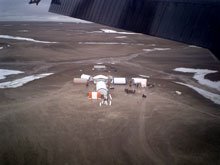
This blog features educational updates on my Devon Island Expedition of July 14-20, 2007. Other sites: spaceref.com/blogs/earthclassroom, www.marsonearth.org

Thursday, December 11, 2008

Wednesday, November 26, 2008
On Cooperation with China
The Case for Cooperation
Leroy Chiao, Ph.D.
Astronaut
November 25, 2008
In October 2003, Yang Liwei became the first Chinese National astronaut to launch into space. He flew aboard the Chinese Shenzhou 5 spacecraft, atop a Long March 2F rocket, launched from the Jiuquan Satellite Launch Center in central China. This historic event marked China’s entrance into the manned space game, only the third nation in the world to have that capability. China recently completed their third manned space mission, Shenzhou 7. During that flight, Chinese National astronaut Zhai Zhigang performed an eighteen-minute spacewalk, using a Chinese-built spacesuit.
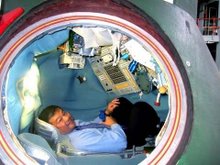
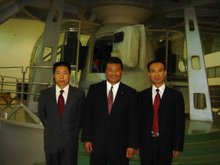
As the first American to be allowed to visit the Astronaut Center of China in September 2006, I saw firsthand, the program’s high-level sophistication and technology. I met with Yang Liwei and Fei Junlong, the commander of China’s second space mission, Shenzhou 6. After a day of tours and meetings, it became apparent to me that the Chinese didn’t lack technology or sophistication, what they had not yet accrued was operational experience. This is something that will come with time.
Having said that, I am impressed with the deliberate, steady pace of their manned space program. Some might say that they have been conservative (their first spacewalk was a short one, and the astronauts never disconnected their electrical umbilicals), but I see it as a series of well-planned quantum steps.
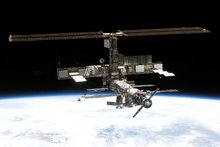
China has, on at least two occasions, publicly announced desires to join the International Space Station (ISS) program. They have thus far, been rebuffed. In 2003, the reason given by the United States was that the Chinese program was too far behind technically and lacked sophistication. In 2007, they were simply ignored. Indeed, I was the lone American astronaut at the International Academy of Astronautics meeting that year in Beijing, China’s first international manned space conference. Except for a few individuals who were able to sign their own travel orders, NASA completely ignored the international assembly of Russian, European, Japanese, Canadian and Chinese astronauts, cosmonauts and space specialists.
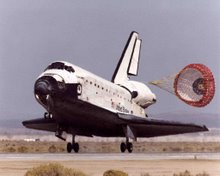
Today, the U.S. space program is facing enormous challenges. The Constellation moon program has continuing technical and budget difficulties, and it is not at all clear what course the new administration will chart when it takes over early next year. The Space Shuttle, arguably a beautiful, magnificent, yet complex vehicle, will be retired in late 2010, barring major budget and political commitments. The United States will have no capability of its own to launch astronauts into space. We will be totally dependent on foreign partners with manned capability. Currently, only Russia is such a partner. China could be the second.
It makes sense politically and programmatically to cooperate with China, in all areas. Space would be a good place to symbolically signal such a shift in policy. The United States did this with Russia in the early 1990’s. At the time, as a skeptic, I didn’t see the point of cooperating with our former enemy and I objected to using our nation’s space program as a foreign policy tool. I thought that the Russians were technically backward. Having grown up during the Cold War, I “knew” these things to be true. It was not until I started training for Expedition 10, that I came to respect the Russians, their technology and their culture. I began to understand the benefits of using U.S. assets and programs to further political friendship through cooperation.
There have been arguments that cooperation in space with China would benefit their missile and weapon capability. Nothing could be farther from the truth. There is nothing in manned space cooperation that would make a ballistic missile more accurate, or a nuclear warhead more powerful. In fact, trying to isolate China might motivate them to further develop their own technology.
Having been rebuffed by the United States on the International Space Station program, China announced plans for a space station of their own. In order to loft this station into orbit, China is developing the Long March 5 rocket, a true heavy lift launcher. This is the most advanced rocket that they have undertaken to create. It features a sophisticated cryogenic core with liquid strap-on boosters. If the U.S. had cooperated with China earlier on ISS, would they have committed their resources to make this 800 metric ton rocket, which by the way, could also lift a huge warhead?
China is emerging as a true world power, economically and technically. Does it make more sense for the United States to engage China, or to try to keep China at arm’s length? I believe that the answer is obvious. It is important to take the global view. Isolationism has been long obsolete. One good way to deal with an adversary is to find common and mutually beneficial areas of cooperation, and turn that adversary into a friend.
Leroy Chiao served as a NASA astronaut from 1990-2005. During his 15-year career, he flew four missions into space, three times on Space Shuttles and once as the copilot of a Russian Soyuz spacecraft to the International Space Station. On that flight, he served as the commander of Expedition 10, a six and a half month mission. Dr. Chiao has performed six spacewalks, in both US and Russian spacesuits, and has logged nearly 230 days in space. He has performed scientific investigations in orbit, and helped to construct the International Space Station. Dr. Chiao was the first Chinese-American professional astronaut, spacewalker and mission commander.
Leroy Chiao, Ph.D.
Astronaut
November 25, 2008
In October 2003, Yang Liwei became the first Chinese National astronaut to launch into space. He flew aboard the Chinese Shenzhou 5 spacecraft, atop a Long March 2F rocket, launched from the Jiuquan Satellite Launch Center in central China. This historic event marked China’s entrance into the manned space game, only the third nation in the world to have that capability. China recently completed their third manned space mission, Shenzhou 7. During that flight, Chinese National astronaut Zhai Zhigang performed an eighteen-minute spacewalk, using a Chinese-built spacesuit.
As the first American to be allowed to visit the Astronaut Center of China in September 2006, I saw firsthand, the program’s high-level sophistication and technology. I met with Yang Liwei and Fei Junlong, the commander of China’s second space mission, Shenzhou 6. After a day of tours and meetings, it became apparent to me that the Chinese didn’t lack technology or sophistication, what they had not yet accrued was operational experience. This is something that will come with time.
Having said that, I am impressed with the deliberate, steady pace of their manned space program. Some might say that they have been conservative (their first spacewalk was a short one, and the astronauts never disconnected their electrical umbilicals), but I see it as a series of well-planned quantum steps.
China has, on at least two occasions, publicly announced desires to join the International Space Station (ISS) program. They have thus far, been rebuffed. In 2003, the reason given by the United States was that the Chinese program was too far behind technically and lacked sophistication. In 2007, they were simply ignored. Indeed, I was the lone American astronaut at the International Academy of Astronautics meeting that year in Beijing, China’s first international manned space conference. Except for a few individuals who were able to sign their own travel orders, NASA completely ignored the international assembly of Russian, European, Japanese, Canadian and Chinese astronauts, cosmonauts and space specialists.
Today, the U.S. space program is facing enormous challenges. The Constellation moon program has continuing technical and budget difficulties, and it is not at all clear what course the new administration will chart when it takes over early next year. The Space Shuttle, arguably a beautiful, magnificent, yet complex vehicle, will be retired in late 2010, barring major budget and political commitments. The United States will have no capability of its own to launch astronauts into space. We will be totally dependent on foreign partners with manned capability. Currently, only Russia is such a partner. China could be the second.
It makes sense politically and programmatically to cooperate with China, in all areas. Space would be a good place to symbolically signal such a shift in policy. The United States did this with Russia in the early 1990’s. At the time, as a skeptic, I didn’t see the point of cooperating with our former enemy and I objected to using our nation’s space program as a foreign policy tool. I thought that the Russians were technically backward. Having grown up during the Cold War, I “knew” these things to be true. It was not until I started training for Expedition 10, that I came to respect the Russians, their technology and their culture. I began to understand the benefits of using U.S. assets and programs to further political friendship through cooperation.
There have been arguments that cooperation in space with China would benefit their missile and weapon capability. Nothing could be farther from the truth. There is nothing in manned space cooperation that would make a ballistic missile more accurate, or a nuclear warhead more powerful. In fact, trying to isolate China might motivate them to further develop their own technology.
Having been rebuffed by the United States on the International Space Station program, China announced plans for a space station of their own. In order to loft this station into orbit, China is developing the Long March 5 rocket, a true heavy lift launcher. This is the most advanced rocket that they have undertaken to create. It features a sophisticated cryogenic core with liquid strap-on boosters. If the U.S. had cooperated with China earlier on ISS, would they have committed their resources to make this 800 metric ton rocket, which by the way, could also lift a huge warhead?
China is emerging as a true world power, economically and technically. Does it make more sense for the United States to engage China, or to try to keep China at arm’s length? I believe that the answer is obvious. It is important to take the global view. Isolationism has been long obsolete. One good way to deal with an adversary is to find common and mutually beneficial areas of cooperation, and turn that adversary into a friend.
Leroy Chiao served as a NASA astronaut from 1990-2005. During his 15-year career, he flew four missions into space, three times on Space Shuttles and once as the copilot of a Russian Soyuz spacecraft to the International Space Station. On that flight, he served as the commander of Expedition 10, a six and a half month mission. Dr. Chiao has performed six spacewalks, in both US and Russian spacesuits, and has logged nearly 230 days in space. He has performed scientific investigations in orbit, and helped to construct the International Space Station. Dr. Chiao was the first Chinese-American professional astronaut, spacewalker and mission commander.
Saturday, November 8, 2008
Chinese Space Suit

On November 7th, I was privileged to be shown the Chinese EVA suit before it was put on display at the Beijing Military museum. I believe that no Americans had seen this suit before. It was a functional suit, though obviously not the one that was worn on the actual EVA in September. That suit was thrown away and destroyed during reentry, except for the gloves that were worn by Zhai Zhigang.
I was impressed with the suit. It has obvious Russian Orlan heritage, with some differences. The Display and Control Module looked similar, as did the pressure regulators and the oxygen injector switch. The hatch latching mechanism also looked similar. So did the umbilical interfaces. In fact, it is reasonable to assume that the spacecraft interfaces are identical to the Russian system, since the second suit worn my Liu Boming was in fact an Orlan.
There is nothing wrong with this approach. It is arguably optimal to take an existing design and improve upon it, while retaining critical systems that are proven. In my view, China is taking a very logical course in developing their manned space capability.
Leroy Chiao
Thursday, November 6, 2008
What a Difference a Year Makes!
Wow, I am blogging to you from China! Only a year ago, I was having dinner with the President of Google China. He told me then, that Google blogs were not turned on here.
Now, they are working just fine. I am glad to see that things are improving. I am encouraged that things seem to be going in the direction of more openness.
China cannot and should not be ignored. We are on the edge of a new era in the United States and the world. Cooperation is the best way to move forward.
Leroy Chiao
Now, they are working just fine. I am glad to see that things are improving. I am encouraged that things seem to be going in the direction of more openness.
China cannot and should not be ignored. We are on the edge of a new era in the United States and the world. Cooperation is the best way to move forward.
Leroy Chiao
Friday, October 24, 2008
Taking a Global View
India has launched a Lunar probe in recent days. Another Soyuz TMA spacecraft has safely landed on Earth (this time with no down-moding of the entry profile). The US is poised to launch a Shuttle in a few weeks. Together with many countries, we operate an International Space Station.
World economies are inextricably linked. Financial crisis spread instantly worldwide. The crash of 1929 affected really only the US. Not this time. Asian stock markets were down 10% overnight. Russia's stock market is down 70% from it's high in May. The US market is down around 40% from a year ago.
Technology has made instant communication possible, to almost any major population center around the globe. How many people do you know who don't have an iPhone or Blackberry? Or at least a cell phone?
Is there any doubt that we live in a time when one must take the global view? Along with that global view, we should look to engage rather than confront. Understanding of other cultures is critical. Learning to put yourself in the other's shoes. When I was in Russia right after their invasion of Georgia, it was interesting to see their point of view. In no way do I endorse or defend their military actions, but my experiences in Russia allowed me to understand.
Through understanding, my hope is that we can all make the world a better place. I'm not naive, if anything, I am a hardened realist. But, everyone should have hope and should strive to help make positive contributions.
Leroy Chiao
World economies are inextricably linked. Financial crisis spread instantly worldwide. The crash of 1929 affected really only the US. Not this time. Asian stock markets were down 10% overnight. Russia's stock market is down 70% from it's high in May. The US market is down around 40% from a year ago.
Technology has made instant communication possible, to almost any major population center around the globe. How many people do you know who don't have an iPhone or Blackberry? Or at least a cell phone?
Is there any doubt that we live in a time when one must take the global view? Along with that global view, we should look to engage rather than confront. Understanding of other cultures is critical. Learning to put yourself in the other's shoes. When I was in Russia right after their invasion of Georgia, it was interesting to see their point of view. In no way do I endorse or defend their military actions, but my experiences in Russia allowed me to understand.
Through understanding, my hope is that we can all make the world a better place. I'm not naive, if anything, I am a hardened realist. But, everyone should have hope and should strive to help make positive contributions.
Leroy Chiao
Tuesday, October 21, 2008
Lowell Thomas Award
Just last week, I was honored by the Explorers Club with a Lowell Thomas award. I was one of six honorees, including a hero from my childhood, Chuck Yeager. Chuck is 85 years old, but he is sharp and gets around easily. I found him a nice man during the few minutes that we spoke on stage. It really was neat to finally meet him.
Leroy Chiao
Leroy Chiao
Wednesday, October 1, 2008
Congratulations Space X!
A few days ago, Space X successfully launched a Falcon 1 rocket, boosting a dummy payload into Low Earth Orbit. Congratulations to the Space X team!
This was the fourth attempt. The first three ended in explosions with loss of vehicle and actual payloads. Space X has been learning that spaceflight is neither easy nor inexpensive. If Elon Musk is willing to continue to spend a lot of money, I am sure he will have more successes in the future with follow on rockets. But, he should expect more problems and more expenses.
This raises into question on how much cheaper he might be able to offer launch services. He also needs to build up a record of demonstrated reliability.
I wish Space X luck. We need more launchers out there to drive down costs!
Leroy Chiao
This was the fourth attempt. The first three ended in explosions with loss of vehicle and actual payloads. Space X has been learning that spaceflight is neither easy nor inexpensive. If Elon Musk is willing to continue to spend a lot of money, I am sure he will have more successes in the future with follow on rockets. But, he should expect more problems and more expenses.
This raises into question on how much cheaper he might be able to offer launch services. He also needs to build up a record of demonstrated reliability.
I wish Space X luck. We need more launchers out there to drive down costs!
Leroy Chiao
Subscribe to:
Posts (Atom)