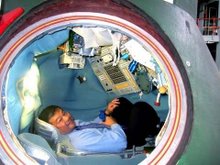
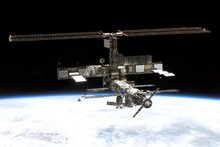
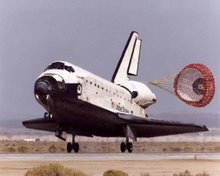
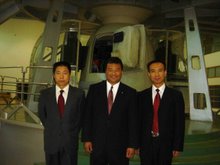
8/08/2008, the lucky numbers that mark the start of this year's Olympic games in Beijing! Several space explorers participated in the opening event and/or the run up to it. Cosmonaut Valentina Tereshkova and the first Malaysian in space, plus the first three Chinese National astronauts all played parts.
Conspicuously absent were US, European and Japanese astronauts. Although the Olympics were created to be a purely sporting event, the games, for the past several decades have become political arenas and a way to make political statements. This, for better or for worse.
I for one, hope that relations between the Western countries (especially the US) and China will improve soon. It doesn't make any sense to ignore or to try to isolate China. I don't defend China for much of what the country's leadership has done in the last century and the beginning of this one, but it seems more effective to engage rather than not.
Call me naive or idealistic, but my hope is that through engagement, we can improve life for everyone on the planet.
Leroy Chiao
Devon Island Expedition
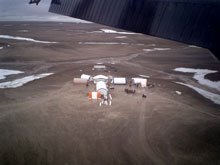
This blog features educational updates on my Devon Island Expedition of July 14-20, 2007. Other sites: spaceref.com/blogs/earthclassroom, www.marsonearth.org

Friday, August 8, 2008

Sunday, August 3, 2008
Space X Launch Failure
Just hours ago, Space X lost it's third Falcon 1 launch vehicle. This is a shame, but it highlights the fact that rockets and spaceflight are complex, difficult endeavors. One of the puzzling facts of this launch, is that it was called Space X's first operational launch. The company had suffered two launch failures in a row, yet felt confident enough to actually put three satellites onto the third and declare the vehicle operational. That doesn't make sense to me. It reminds me of the maiden launch of the Ariane V, which also carried satellites. That rocket too was destroyed early into the flight, with the loss of all payload.
Despite all of this, I do applaud their efforts. Space X was founded in 2004 with the noble idea that there had to be a better and more efficient way to get to orbit. At the time, one major stated goal of the company was to create operational launchers by 2006 which were so efficient that the cost per pound of payload would be reduced by a factor of ten, from $10,000 per pound to $1000 per pound.
Now we are in the second half of 2008 and Space X has not yet successfully launched a rocket to orbit, let alone successfully launch payload for $1000 per pound.
All of the nations which developed successful rocket programs had spectacular failures before getting it right, including Germany, the US, Soviet Union, China, Japan and France. Currently, several countries including India, Iran and North Korea have naescent rocket programs.
If Space X stays at it, I am sure that they too, will be successful. I remain a big believer in the potential for commercial space, including commercial manned spaceflight. But, it's not going to be an easy or quick journey to success.
Leroy Chiao
Wednesday, July 30, 2008
Wristwatches
Pilots, astronauts and their wristwatches, right? There is something about a nice wristwatch. From the beauty of its design to the beauty of it's engineering to the combination of elegance and functionality, a wristwatch to many of us is more than a practical tool.
I recently did a detailed interview and podcast with Jake Ehrlich, who is a Rolex afficianado. You can check out his blog and my interview/podcast at:
http://rolexblog.blogspot.com/2008/07/story-of-nasa-astronaut-leroy-chaio-his.html
I've worn a few different watches in space, including Rolex, Omega and Breitling. But, it is a Rolex GMT Master that I own. That watch flew with me on every space mission. I acutally bought the watch in Davos, Switzerland, before I was selected as a NASA astronaut.
After leaving NASA at the end of 2005, a friend of mine at Rolex had it inscribed for me with my name and space mission designations.
Do you have a favorite timepiece?
Leroy Chiao
Saturday, July 26, 2008
UFO's, Aliens, Coverups?
This week, I read a news article, where Ed Mitchell, an Apollo moonwalker, claimed that the US Government has known about and covered up alien encounters for the last sixty years. This is astounding and one's first thought is whether or not this person is thinking clearly.
I found these asserions interesting, because another early astronaut, Gordo Cooper (whose first name was Leroy, I being the only other astronaut with that name) made the same assertions years ago. Gordo and Ed both claimed to have chased UFO's in their interceptor jets while on active duty in the US military. Ed claims to have received top secret briefings on the existence of aliens. He also claims that the Roswell incident was a real UFO encounter and that the aliens who have allegedly visited are small in stature with large heads and eyes.
During my four missions in space, I saw a few strange things, but these were probably explainable as either natural phenomena or man-made hardware. I never thought for a minute that any of my sightings were alien spacecraft with living creatures aboard.
Ed's assertions, along with those earlier from Gordo give me reason to pause for a moment. I absolutely believe that there is life elsewhere in the universe, I am however, skeptical that that other life has found and visited us. I do maintain an open mind though.
What do you think?
Leroy Chiao
Friday, July 11, 2008
Mobile Me and Other Improvements?
Mac users who used dot Mac got "upgraded" to Mobile Me a few days ago. To date, the dot Mac page, which was supposed to seamlessly connect one to the Mobile Me page, doesn't work and hasn't for almost three days now. I can get to my email, since I figured out that I can go directly to the "me" page. However, the mail is SO SLOW that it is almost unusable. Also, there are issues with trying to print. This and the site was quite unstable today, locking up and crashing several times. I finally reverted to doing Email on my iPhone, which was a LOT faster and worked. That's quite a statement.
What happened to Apple? Usually, their releases are relatively well-tested and stable. This is strange. Couple this with the fact that a friend of mine bought one of the very first iPhone 3G's, lining up outside the local Apple Store. As employees tried to port over her phone number from her old iPhone to the new, the process froze. She was caught in transition. Now, neither phone works and the Apple Store had no answer. The same happened to several customers and the store suspended sales of the new iPhone.
When is better the enemy of good enough? What is the right balance of moving forward and staying with the tried and true? Some time ago, I wrote about getting Microsoft Word 2008 for the Mac. It is terrible and I make all efforts not to use it. I only use it when I receive a file that requires 2008 to open. It is much slower and cumbersome, in addition to being A LOT slower to start and to do other operations.
This is why software on spacecraft are only upgraded after extensive testing. Also, modifications are only made when really necessary. This is prudent because lives are literally on the line. The same standards should not be applied to commercial software, but I can't help but observe that Apple dropped the ball on this one. Clearly, the product was not adequately tested and/or is simply too cumbersome. I hope they get their act together, as I am a long-time Apple supporter.
Leroy Chiao
Saturday, June 21, 2008
Life in the Universe
Congratulations to the Phoenix team! It is exciting to read about the apparent discovery of ice on Mars. This has vast implications of course, with one being the possibility that life once existed there.
I firmly believe that there is life elsewhere in the Universe. I believe that we will discover other Earth-like planets in addition to discovering life in remote, hostile areas like Mars.
Now, the question on whether or not Earth has been visited by aliens is different topic. Although an intriguing idea, I am skeptical that we have been visited by other intelligent beings. I myself have seen odd things, including in space, but they have all turned out to be explainable events.
What do you think? Are we alone in this Universe? Will someone invent the warp drive soon and allow us to explore farther with probes and astronauts?
Leroy Chiao
Tuesday, June 17, 2008
Congratulations, Japan
The Japanese Experiment Module Kibo is now on orbit and installed onto the ISS and activated. Congratulations Japan and their newest astronaut, Aki Hoshide! My good friend Koichi Wakata will be flying the first Japanese long duration flight early next year. Enthusiasm there is very high.
What is the future of government space? China will launch the Shenzhou 7 mission later this year (probably October), after the Olympics. The US will retire the Shuttle in 2010. What will become of the Constellation program and Orion after the elections in November? Countries like Japan and the members of ESA are totally dependent on US and Russian assets for manned access to space. After 2010, the Russians will be the only government game in town, except for China, which has so far been rebuffed in their desire to be an ISS partner.
What does the future hold?
Leroy Chiao
Subscribe to:
Posts (Atom)